Contact us
Get in touch with our experts to find out the possibilities daily truth data holds for your organization.



What happens when you strengthen your ground network, enhance satellite capabilities and expand your fleet?
Faster reaction times, right?
Not necessarily.
Without efficient orchestration, these system advances do not automatically translate into lower latency. In some cases, they even increase it.
This is why planning matters. In this blog post, we take a closer look at:
What planning is
How we optimize it
The scale of the challenge
Planning is the process of determining when, where, and how satellites capture SAR imagery of the Earth’s surface.
It begins when a customer submits a tasking request for their image, specifying parameters such as area of interest, required resolution and, in some cases, a time window for capture.
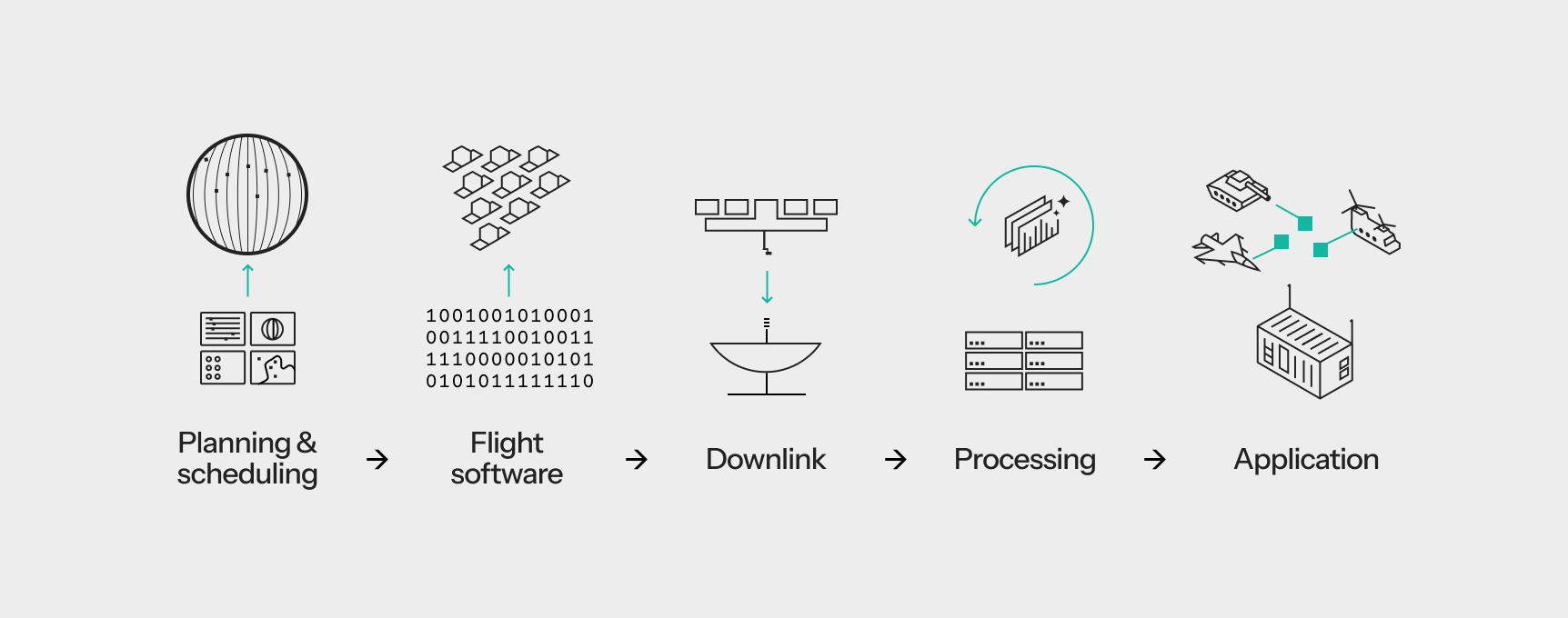
Our system calculates all possible opportunities for our satellites to take the image. The task then joins all the other tasks in the planning cycle, where our algorithm sorts them into an optimized schedule to be uploaded to our satellite fleet.
While we aim to schedule as many tasks as possible, the algorithm is not designed to pick the maximum number of tasks every time. It follows priority rules that prioritize certain tasks, even if that results in a lower volume of captured images overall.
Getting the planning cycle right is no mean feat.
Each planning cycle spans 30 days, during which we handle thousands of tasks. Together, they generate today around 15,000 to 20,000 imaging opportunities, which adds up to a vast solution space and increases exponentially as we add more satellites to the fleet.
Finding the mathematically optimal solution for each cycle is an NP-hard problem – so we do not even attempt it. Instead, our algorithm is designed to find a very good solution in a reasonable amount of time.
Planning is baked into reaction time. If the planning algorithm takes two hours, then the decision maker will have to know their targets at least two hours in advance . Improving the speed and efficiency of the algorithm therefore has a direct impact on latency.
At ICEYE, we have managed to condense our entire planning process into a period of just a couple of minutes. This includes the time needed to generate opportunities as well as the time it takes to run the algorithm.
If a ground station connection is available, the optimized schedule can then be uploaded to the fleet almost instantaneously.
Latency reduction in the planning process does not happen in a vacuum.
When determining when and where satellites capture images, two other key factors come into play: coverage (how many images are captured) and quality (how much data is collected per image). These three factors – latency, coverage and quality – form a triangle-like relationship, where changes to one automatically affect the others.
Traditionally, it has only been possible to optimize for two factors at the same time. For example, prioritizing quality and speed means sacrificing coverage while a large volume of high-quality images will take longer to collect.
While these trade-offs cannot be eliminated entirely, we have been developing strategies to make them significantly less extreme, enabling our customers to prioritize all three simultaneously.
The real game changer here has been our new constructive planning algorithm, which is able to reassign already-scheduled images when more time-critical tasks enter the system.
This addresses a key prioritization challenge.
High-priority tasks are not always time-critical – and vice versa.
Now let’s take two imaginary tasks. The first to enter the system is high-priority but not time-critical (Task A and B in the animation below). There will be multiple opportunities to schedule the image across a given week or month. The system will pick the earliest opportunity it can.
The second task to enter the system is lower priority (Task C in the animation below)– but it is time-critical. In the past, this would have made no difference: the already scheduled task would have retained its place in the pecking order. Our new algorithm, however, can reassign the first, less time-critical task to another opportunity within the acquisition window, even though it is higher priority.
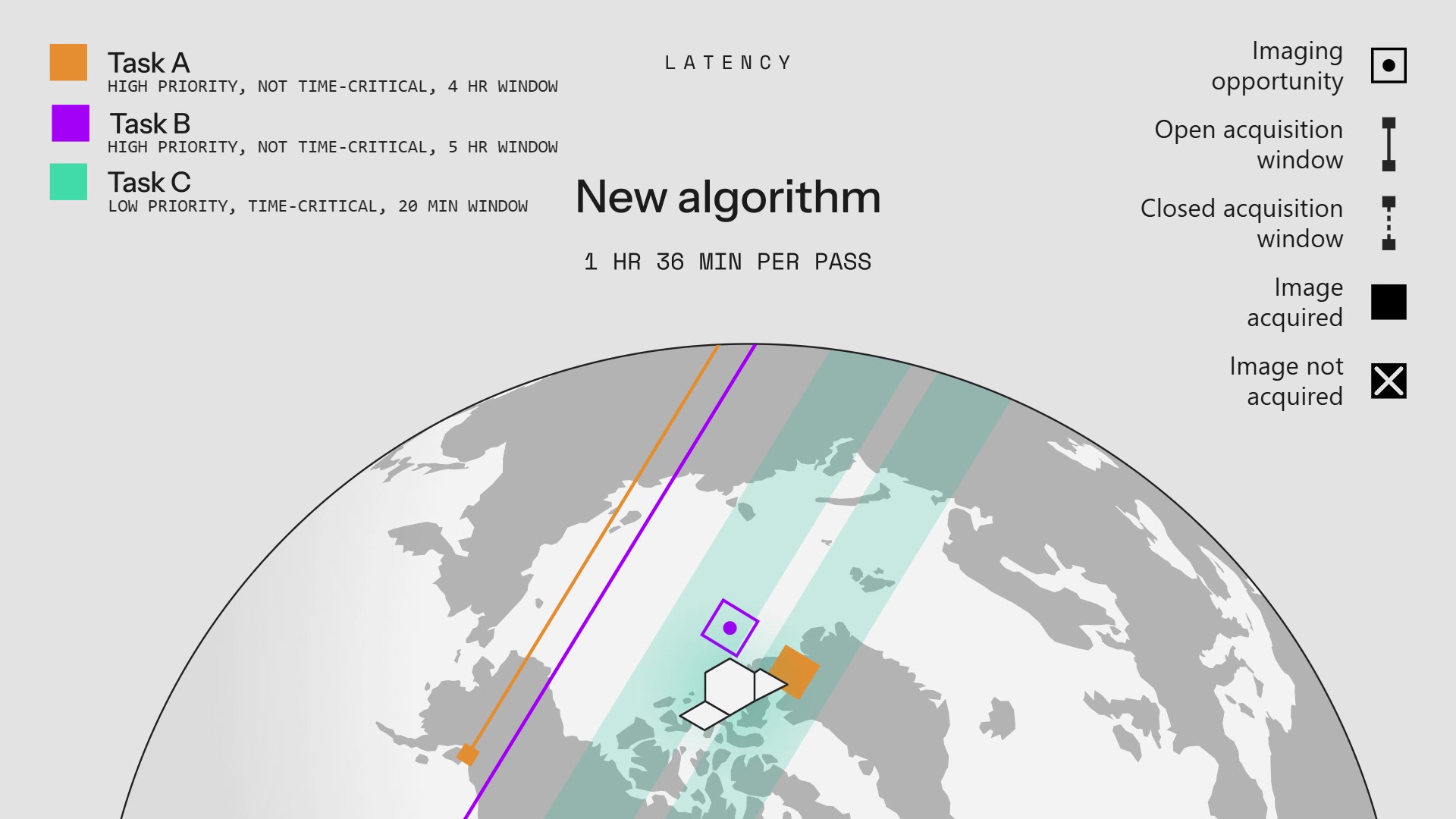
Figure 1. In this animation, Tasks A and B have higher priority but are not time critical, featuring broad acquisition windows of 4 and 5 hours respectively . Conversely, Task C has a lower priority but is highly time critical with a narrow 20-minute window. Under the legacy algorithm, tasking opportunities could not be rearranged , and Task C would fail to acquire an image. The new algorithm, however, dynamically shuffles tasks and their opportunities within their allowed windows, successfully capturing task C without violating its strict acquisition window requirements. Note: For simplicity, this animation assumes a single-satellite fleet.
This allows us to take better advantage of flexible time windows, increasing overall task completion and reducing average wait times.
The change in algorithm enabled us to schedule significantly more images in congested regions – an increase of approximately 8%.
Planning extends beyond imaging. It also involves securing the right ground segment resources – coordinating with ground station providers to ensure capacity is available where and when it matters most.
We are currently developing a dedicated service to manage ground station pass booking more effectively. This will allow us to systematically account for factors such as station reliability and downlink capacity when selecting passes to book, instead of simply optimizing the start time of the downlink.
The impact on latency is significant. High-performance ground stations enable faster, more reliable data transfer, directly reducing downlink time. By intelligently selecting the best available connections for each task, we can further compress the end-to-end delivery timeline.
Latency is not just about what happens in ideal conditions. It is also about how quickly the system can respond when things do not go to plan.
We have built multiple feedback mechanisms into our system, which can detect anomalies across the fleet. If an image acquisition fails, the satellite sends a notification, triggering an immediate replanning cycle. The system then reschedules the task, either with the same satellite or another – whichever is fastest.
The same principle applies to ground stations. Our algorithms validate incoming data and flag any inconsistencies. If data loss is detected, the system automatically schedules a new downlink at the next available opportunity.
What is more important for reducing latency: adding more satellites, or managing existing ones more efficiently?
At ICEYE, we do not see it as a binary choice.
While we continue to expand our fleet, we also recognize that effective planning is one of the most powerful levers for accelerating time to decision. In fact, improvements to planning algorithms will often deliver gains comparable to deploying additional satellites.
This is especially true for customers operating sovereign constellations, where efficient utilization has an even more significant impact due to the relatively small size of the fleet.
ICEYE set a 15-minute latency target back in 2019; this post explains how the whole system has been rebuilt around making that a repeatable baseline, not just a best-case result
05 August 2026
28 July 2026
28 July 2026