Contact us
Get in touch with our experts to find out the possibilities daily truth data holds for your organization.



It’s one of the key challenges our teams have been focusing on in recent years.
For a long time, synthetic aperture radar (SAR) was mainly associated with long-term monitoring. But with tactical uses growing fast, timing is becoming increasingly critical for our customers. It’s no longer simply a question of how good we can make the image. It’s about how quickly we can get the insights behind the image into the hands of decision-makers and those at the tactical level.
Today, latency matters more than ever.
Ask ten people and you’ll probably get ten different answers. Some define it as the time between image capture and availability. Others prefer to measure it from when a satellite is tasked to when the data is delivered.
But for us, latency is time to decision.
It’s not just about producing an image. It’s not just about delivering data. Both are important, but they’re ultimately just means to an end. What really matters is how long it takes for actionable insights to reach the people who need them.
And when those insights are being used for tactical decision-making, we need to think in minutes, not hours.
Back in 2019, we set ourselves a latency target of 15 minutes. It was achievable at that point, but only in ideal conditions. Our goal has been to make it a repeatable standard that our satellites and systems can achieve day in, day out.
A useful way to think of it is like building a tunnel. You start by drilling a small hole through to the other side, just to prove it’s possible. Then, over time, you widen and reinforce the hole until it becomes a piece of usable infrastructure.
Six or seven years ago, we were at the hole-drilling stage. Since then, we have been expanding the tunnel step by step, getting ever closer to making 15-minute latency our baseline.
There is no single fix for latency. It’s a system-wide challenge that needs a system-wide approach.
That is why we have been examining key stages of the process and asking how we can go faster:
Planning and scheduling – how quickly can we define areas of interest and select optimum time windows for satellite observation?
Flight software – how efficiently can our satellites operate when collecting and transmitting data?
Downlinking – how can we reduce the amount of time it takes to get data to ground stations?
Processing – how fast can we turn raw SAR data into usable insights?
Application - what is the impact of latency reduction in real operational environments?
Let’s take each of those areas in turn and look at some of the answers we’ve come up with.
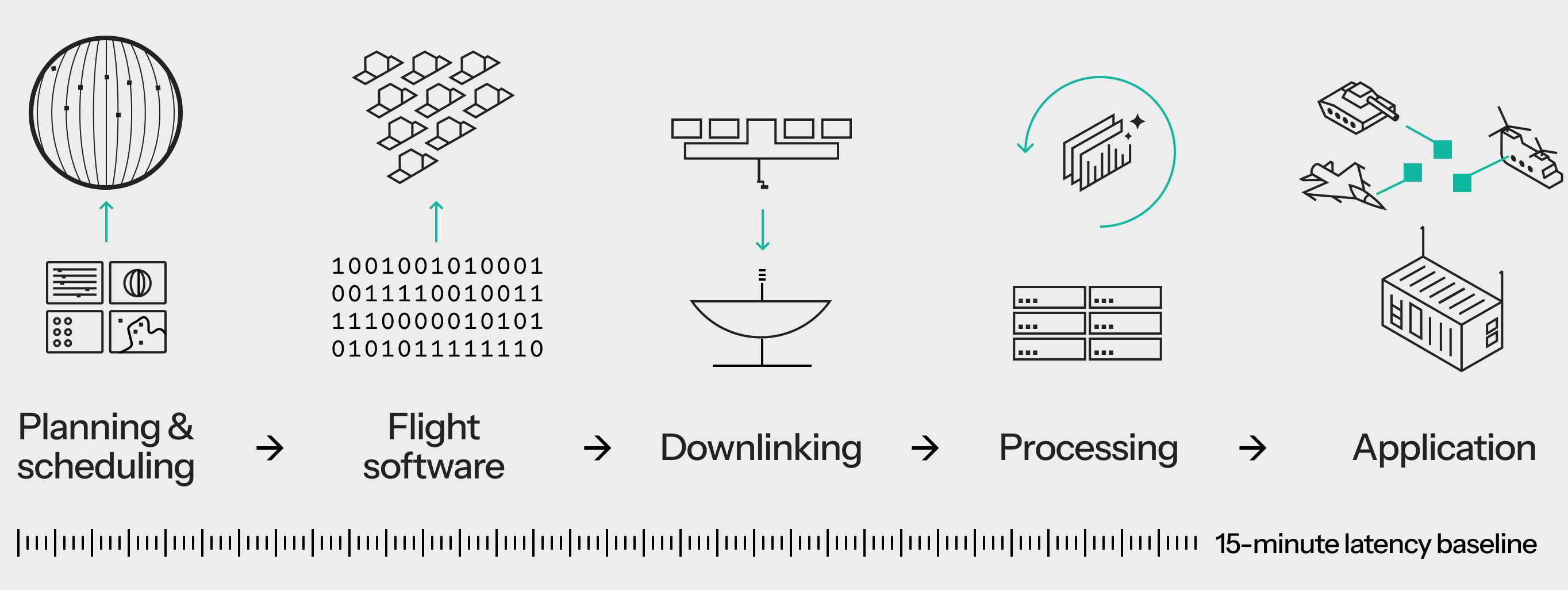 Figure 1. Latency is a system-wide challenge that requires a system-wide approach. We've identified five key stages of the process ; planning & scheduling, flight software, downlink, processing and application.
The OODA Loop, also sometimes referred to as sensor-to-action loop, will be familiar to anyone who’s worked in military or business strategy. Standing for Observe, Orient, Decide, Act, it’s a decision-making framework developed by US Air Force Colonel John Boyd in the 1970s. It was designed to help forces operate faster and with greater agility.
The success of the model depends on your ability to close the loop. In other words, how soon after completing one decision-making cycle can you use the results to begin the next one?
This is why efficient tasking is so important. The quicker we can generate and send commands to the satellite fleet, the faster the whole system moves.
There are two main ways to speed up tasking. The first is by building more powerful algorithms. The second is by creating practical shortcuts. Creating faster planning algorithms is a constant balancing act between mathematics and computer science. If the algorithm explodes exponentially in complexity, there is no amount of computer science in the implementation that can ultimately fight against exponential growth.
Many times, however, we can make huge speed improvements in the implementation without touching the mathematics at all.
Practical shortcuts are in our case usually about restricting the problem size significantly. If we can replan a specific time window for a specific satellite, it’s obviously going to be multiple orders of magnitude faster than replanning all the tasks for the entire fleet.
AI will play an increasingly significant role in speeding up tasking decisions. As satellite constellations grow, revisit times are getting shorter and larger numbers of images are being used in the OODA loop, along with other sensors and sources such as social media. As a result, the pressure to increase the frequency of the loop is growing beyond what can be achieved with human capabilities alone.
Early ICEYE satellites could only execute a single activity at a time. At any given time, they were either imaging or downlinking data. Our Gen3 and Gen4 satellites, however, are built to do both simultaneously.
Thanks to our software updates, the onboard computer can now fully exploit these capabilities by initiating downlinks regardless of the satellite’s imaging state. This removes unnecessary waiting time, as data can be sent to the ground almost immediately, even while subsequent images are still being collected.
It might sound strange to launch satellites with capabilities we haven’t fully unlocked yet – but it’s a very deliberate strategy. Updating software is relatively easy compared to getting hardware into space. Rather than waiting until every software capability is complete, we prefer to launch the hardware first and then continue to develop and test the software while the satellite is in orbit. This allows us to move and learn faster, and continue improving performance over time. Some companies are labelling this as "software defined satellites". For us, it's part of standard operating procedure.
How do you reduce latency in downlinking?
The obvious answer is to increase downlink capacity so you can push more data back to the ground in less time. But as file sizes grow, that approach can only take you so far.
For a longer-term solution, we are also looking at ways to reduce the amount of data that needs to be moved in the first place.
The first way of reducing the amount of raw data is to look at the compression techniques we are using. Some efficient compression methodologies are lossy (i.e. permanently discard data to reduce file size), but if we are aggressively optimizing for speed, we have found that the loss of quality linked to lossy compression is often acceptable for tactical use cases.
Another approach is to shift more computing onboard the satellite. Instead of downlinking raw data and processing it on the ground, we can process it in orbit and send back only what matters – the actionable insight. That dramatically reduces the volume of data we need to transmit, which in turn reduces latency.
Yet another approach is to improve connectivity. This can be achieved by expanding ground station network coverage as well as by enabling customers to set up their own sovereign ground assets. There is also the potential to use space-based transport layers, which allow us to move towards continuous communication with the satellite, rather than relying on intermittent ground station passes.
Put all those together – less data to send, more opportunities to send it , improved connectivity – and you begin to make a real dent in downlink-driven latency.
In an ideal world, you would always choose to have the best possible image quality. But image quality comes with trade-offs: namely, more data and longer processing times. And, in tactical scenarios, longer processing times are the last thing anyone wants.
To reduce latency, we now give users the option to prioritize time-to-insight. This includes offering one-look and two-look Spot variants, which accelerate processing by reducing dwell time and file size. Our customers can freely choose the imaging mode that is best suited for their needs at the time.
In addition, we can use new processing algorithms that optimize for speed instead of scientific accuracy. When combined with accelerated computing, this has allowed us to cut processing times by more than half in the last year (down to under 5 minutes for one-look and two-look Spot variants). The key is being able to select the right tool for the job i.e. the imaging mode best suited to the task at hand.
We’re also using AI to accelerate the final step: turning data into insight. For example, we’re building automatic target recognition (ATR) into our pipeline, so users receive processed insights rather than raw SAR images that they have to analyze themselves. This is already leading to inference times that can be measured in seconds rather than minutes.
The impact of latency reduction becomes clearest when deployed in real operational environments.
During the multinational military exercise, ORION 2026, ICEYE’s ISR Cell was embedded directly with a French Army infantry brigade, delivering near-real-time satellite imagery and analysis to support targeting coordination.
The deployment demonstrated how space-based ISR can contribute directly to the sensor-to-action loop. By combining satellite intelligence with other data from drones and other reconnaissance units, forces were able to accelerate decision-making and improve situational awareness at the tactical edge.
This highlights a broader shift in how SAR capabilities are being used. Space-based intelligence is no longer operating solely as a strategic or long-term monitoring asset. Increasingly, it is becoming part of time-sensitive tactical workflows where speed, responsiveness, and the ability to deliver actionable insight in minutes can have a direct operational impact.
The space-based ISR industry has undergone a fundamental shift.
For a long time, the focus was on improving image quality. But in recent years, a new priority has emerged. Now it’s not just about how much you can see, but how quickly you can act on it.
As we’ve seen, there is no silver bullet for latency. It requires a coordinated effort across the entire system, including smarter tasking, faster downlinking, more capable flight software, AI-driven analysis and larger, more responsive satellite fleets.
And that’s what puts ICEYE in such a strong position.
Our customers and partners can trust us to achieve the 15-minute latency baseline because we have:
● The world’s largest SAR satellite fleet
● Full control of the technology stack, from space to insight
● Proven operational capability
● A highly responsive and committed team
Ultimately, latency is more than a technical metric. It is the difference between simply seeing what has happened and having the ability to act on it. That is why latency reduction continues to be a key focus for our engineering teams.
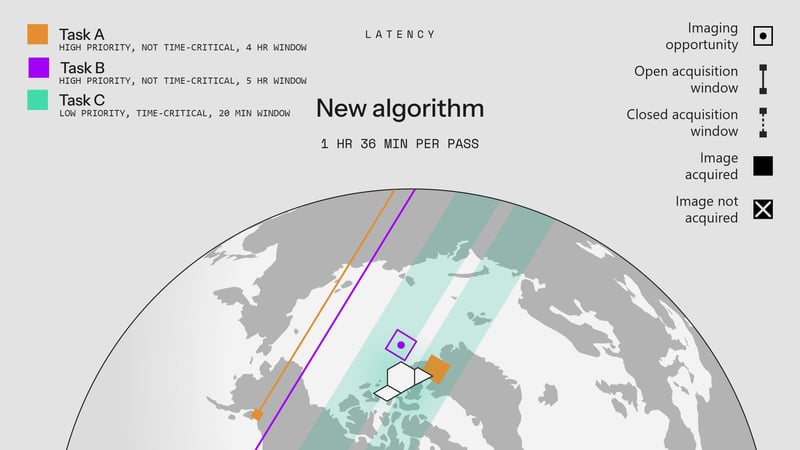
We'll unpack how acquisition planning generates opportunities, coordinates schedules across the fleet, and why smarter algorithms can be as impactful as putting more satellites in orbit!

15 October 2026
12 October 2026

07 October 2026