Contact us
Get in touch with our experts to find out the possibilities daily truth data holds for your organization.


The UK Prudential Regulation Authority's (PRA) Supervisory Statement 5/25 came into force on 3 December 2025. SS5/25 requires banks to assess physical climate risk at asset level across their lending portfolios, integrate it into credit and capital processes, and demonstrate that their data is granular and defensible enough to withstand supervisory scrutiny.
Following publication, firms were granted a six-month gap assessment period, which ended on 3 June 2026, to assess their existing capabilities against the requirements. This was intended to enable firms to demonstrate that they have clearly structured, appropriately approved, and proportionate measures in place to support effective climate risk management.
For many banks, this presents a genuine challenge, particularly with the climate data required, given the limitations of flood models, which are designed to estimate the probability of flooding rather than report on actual flood events. This means that banks simply do not know where a flood has occurred and who has been impacted. That is where ICEYE's satellite-derived flood insights can help bridge the data gap.
SS5/25 requires embedding physical climate risk in credit risk, collateral valuation, ICAAP, and IFRS 9 ECL calculations across the full range of lending activity: residential and commercial mortgages, SME lending, corporate loans, and real estate finance. The PRA is clear that the regional proxies and postcode-level hazard scores generated by models are no longer sufficient. What is now required is asset-level assessment, granular enough to understand the impact of climate change at the individual customer level and withstand direct supervisory scrutiny.
The Cambridge Institute for Sustainability Leadership's (CISL) Banking Environment Initiative (BEI), in its May 2026 report Resilience-Adjusted Credit Risk: Operationalizing Climate Adaptation in Financial Decision-Making, developed with HSBC, NatWest, Deutsche Bank, and ABN AMRO, cites industry survey data showing that only 18% of banks have integrated physical risk into Internal Ratings-Based (IRB) models, with capital-level integration, such as ECL, RWA, and economic capital, remaining largely exploratory. The bottleneck, on this evidence, is not intent, but rather the data itself.
SS5/25 recognizes the data shortfalls in probabilistic hazard models, which the PRA has flagged as insufficient on their own, and requires banks to address this gap in their data. The BEI report acknowledges that its own proposed framework currently carries no empirical weighting, with calibration identified as a priority for future research.
This is precisely the evidentiary gap that ICEYE’s observed event data is positioned to close.
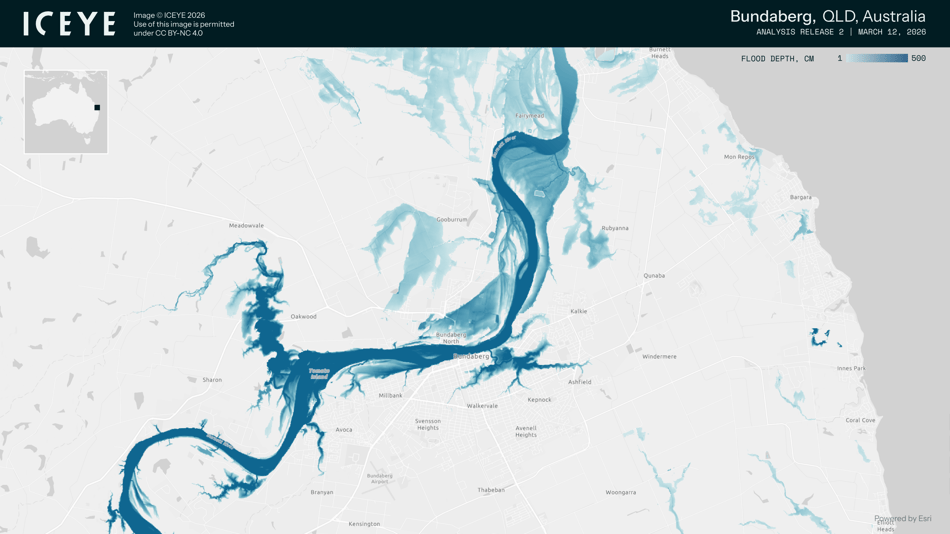 Above: An example flood insights map
A more basic problem sits beneath the requirements SS5/25 now places on banks. Banks have extremely limited data on whether a specific property has been flooded.
The hazard models that banks rely on estimate flood probability, i.e., the likelihood that a property in a given zone will flood over a given return period. They are not designed to report when a flood has actually occurred, which properties were inundated, or to what depth.
For residential lending, UK mortgage terms require borrowers to notify their lender of material property damage, but in practice very few do. After a flood, borrowers focus on their property and family, not their lender. The challenge is similar in commercial lending. A business borrower may continue servicing a loan while absorbing disruption through reduced margins or emergency expenditure, leaving the lender with no visibility of the stress building beneath a performing credit.
As a result, banks hold loan books with no reliable record of which assets have been flooded, when, or how severely. This absence of event-level data is an issue banks must now address under SS5/25. Without this data, they cannot realistically triage portfolios after an event, assess customer resilience, monitor collateral on an informed basis, or test whether prior flood exposure is already embedded in credit performance.
When a property floods and the bank is not aware, the consequences can play out slowly and invisibly. For residential borrowers, uninsured or underinsured losses are absorbed through depleted savings and deferred repairs, with the loan payment protected until the last possible moment. For commercial borrowers, a flooded warehouse, retail unit, or office building generates repair costs, business interruption losses, and potential loss of tenants or trading capacity.
A bank's credit file records whether insurance exists – at least at inception, not whether its limits and exclusions are adequate relative to actual flood damage. The loan performs. The credit file looks clean. Months or years later, when a credit event occurs, it's logged without any reference to the flood that might have caused it.
The BEI report names this attribution failure as one of six structural barriers to progress. Each barrier reinforces the next: losses that go unrecorded fail to build the urgency, or the evidence, needed to unlock investment in resilience. The report warns that action is needed before losses currently misclassified begin to surface at scale.
Consumer behavior compounds the problem: flood-affected borrowers protect loan payments, absorbing financial stress before a credit event surfaces, sometimes years after the event. Banks calibrating flood risk against historical bad debt data may be measuring a signal systematically delayed by borrower behavior.
Consider what this means for a borrower whose property has flooded three, four, or five times in five years, a pattern which ICEYE's UK data shows is not exceptional in highly exposed communities. Each flood compounds financial pressure. Each time, the credit files record nothing. With insurers starting to pull back from some high-risk areas of the market, the uninsured share of that cumulative burden is growing.
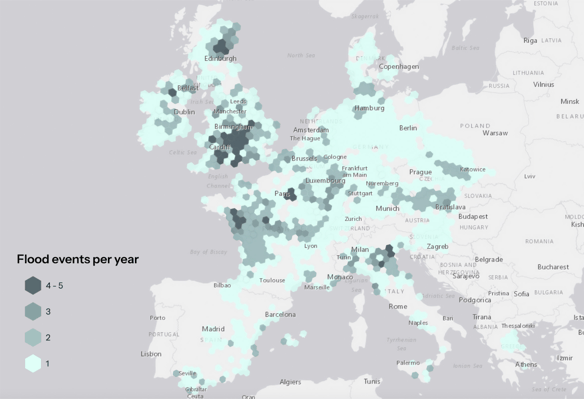 Above: Flood events per year across Europe observed by ICEYE
Probabilistic models were designed to answer one question: what is the probability this property will flood? SS5/25 requires banks to go further and assess actual asset-level exposure, integrate it into credit decisions, and demonstrate that their data is granular and defensible enough to withstand supervisory scrutiny. Observed event data is the most direct way to meet that standard.
ICEYE operates the world's largest constellation of Synthetic Aperture Radar (SAR) satellites, imaging any point on Earth through cloud cover, at night, and under flooding conditions.
.png?)
Flood solutions in action
Above: A video demonstrating how ICEYE monitored Storm Babet in the UK
In the UK, our catalog spans five years from 2021 to the present, covering 25 observed flood events. Our data identifies individual properties inundated three, four, and in some cases five times within that window, a repeat flood picture invisible to other data sources available to lenders.
For credit monitoring, we enable banks to overlay an observed flood footprint against their loan book within hours of an event, identifying affected borrowers at address level. Affected accounts are flagged for proactive outreach, forbearance decisions made on an informed basis, and IFRS 9 provisioning reviews triggered with a documented evidentiary foundation, before a missed payment, not after.
For collateral valuation, where SS5/25 requires banks to reflect physical climate risk in their assessment of asset values, our observed inundation data provides the factual basis for revaluation decisions and IFRS 9 impairment reviews, particularly for commercial real estate where a flood can impair both the physical asset and the income stream it generates.
For back-testing and model calibration, our five-year UK archive enables banks to ask, for the first time and at scale, whether loans secured on confirmed flooded properties subsequently underperformed relative to comparable unexposed loans. This is the empirical foundation the BEI report identifies as a gap in even the most advanced current frameworks, and on which PD and LGD adjustments can be calibrated using observed data.
For regulatory defensibility, a satellite-derived measurement of the level of water inundation at a specific property on a specific date is a recorded observation, not an inference. This directly addresses the black box frustration the CISL BEI report documents and provides evidence a bank can present to the PRA with confidence.
From gap assessment to remediation: With SS5/26 gap assessments done, banks understand the gaps in their current approach. ICEYE supplies the observed data that makes closing them operational, including five years of UK flood history already answering questions current models cannot.
Banks that are among the first to integrate satellite-based flood intelligence will be well positioned to meet the PRA's near-term expectations while gaining an early understanding of the flood-related risks already embedded within their portfolios, before those risks emerge at a scale that limits their ability to respond.
To find out more, visit https://www.iceye.com/solutions/banking or get in touch directly.
ICEYE for banking
Use observed, near-real-time flood data to identify which properties and borrowers are impacted.
30 September 2026
24 September 2026
03 September 2026