Contact us
Get in touch with our experts to find out the possibilities daily truth data holds for your organization.


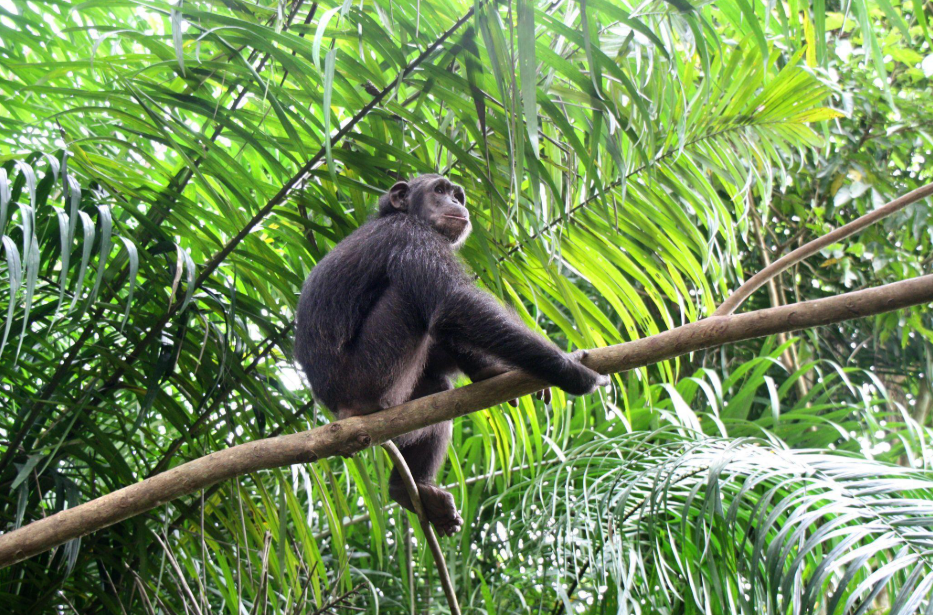
Photo courtesy of Jane Goodall Institute & Anna Mosser
In April 2026, ICEYE and the Jane Goodall Institute USA (JGI) announced a partnership to deploy ICEYE's Deforestation Solution across conservation corridors in the Congo Basin, with initial operations focused on the eastern Democratic Republic of the Congo. The region's rainforests, the second-largest on Earth, are home to the highest combined biodiversity in Africa. Yet they face mounting pressure from habitat destruction and deterioration, illegal hunting, cross-species disease transmission, and illegal wildlife trafficking. The scale of the problem is global: chimpanzee populations across Africa are critically endangered. It is now estimated there are fewer than 300,000 chimpanzees left in the wild, with populations severely fragmented and decreasing. We spoke with Dr. Lilian Pintea, head of Conservation Science at JGI, about why SAR has become central to their conservation strategy and what the partnership unlocks on the ground.
What is JGI's mission in the DRC, and where does deforestation monitoring fit in?
 Dr. Lilian Pintea: Our closest living relatives sit at the front line of a habitat crisis. Four threats define the work: habitat loss and degradation, illegal hunting and trade, disease spillover (respiratory diseases, Ebola, Simian Immunodeficiency Virus (SIV), transmitted from chimpanzees to humans, where it evolved into HIV and causes AIDS, and others that move both ways between humans and chimps), and the illegal pet trade. The mix shifts by geography. In Tanzania, the primary threat is habitat loss and fragmentation. In eastern DRC and the Republic of the Congo, illegal hunting dominates, but habitat loss is accelerating fast through agriculture such as palm oil, unregulated mining, both legal and illegal logging, road expansion, and settlement growth inside dense forest.
Knowing which threats matter most, where they are happening, and which human activity is driving them helps shape our interventions and funding priorities. Deforestation monitoring is how we turn that from anecdote into evidence.
What makes monitoring deforestation in the DRC so difficult?
Dr. Lilian Pintea: Africa is under-mapped. In many areas, basic data infrastructure is limited, so satellite imagery is often the best map available. Add persistent cloud cover, dense canopy, and security conditions that make some areas physically unreachable, and the operational picture becomes very hard to build from the ground.
We have used Landsat, SPOT and other moderate-resolution satellite imagery since 2000, 1 m IKONOS imagery in Gombe since 2001, QuickBird at 60 cm resolution since 2005, and Google Earth Engine for large-scale classifications across the entire chimpanzee range in Africa beginning in 2012. Optical imagery has carried us a long way, but it also has hard limits. In the wet season, clouds block everything. In some years we would only get one or two usable Landsat scenes, and decision-makers kept pushing back with the same question: this is great, but it happened last year. What happened last week?
When did JGI first start working with ICEYE, and what prompted it?
Dr. Lilian Pintea: The trigger was illegal mining under the tree canopy in eastern DRC, where mining operations are often controlled by armed rebel groups. Protected area rangers were walking into those areas without knowing what was in front of them. Conservation practitioners on the ground needed a signal that could see through the canopy and through clouds, at a tempo that actually protects rangers and informs decisions.
The areas involved are enormous. The Great Ape Conservation Action Planning area supporting the Ushiriki consortium, a multi-stakeholder alliance led by JGI in close collaboration and partnership with the local government, community organizations and other NGOs in eastern DRC, is roughly half the size of California, with rugged terrain, poor roads and limited access. We started evaluating SAR sources for one specific reason: to detect activity that optical sensors physically cannot see. That search led us to ICEYE.
How critical is SAR's ability to see through clouds?
Dr. Lilian Pintea: Essential. With optical imagery alone, in many parts of the chimpanzee range like in the western Republic of the Congo (ROC) or eastern DRC, we can characterize, at high resolution, habitat change once a year at best. Optical satellite imagery providers improved that, but cloud cover and the limits of optical sensing remain. SAR gives us objective, timely observations independent of weather and daylight. In contexts like Virunga or Maiko National Park in the eastern DRC, near real-time information is not a nice-to-have; it is what could potentially help rangers stay alive as they operate in extreme conditions far from their families.
How will ICEYE data be used operationally?
Dr. Lilian Pintea: Three ways. First, it complements our existing optical workflows, including the chimpanzee habitat health Decision Support System (DSS) that we built with the University of Maryland in 2016, and the OPERA alerts we are validating under a NASA grant in Uganda and Tanzania. Combined signals produce deforestation alerts that are both more accurate and more timely and feed directly into conservation action plans and the adaptive management framework we share with local governments and partner NGOs.
Second, the data goes to local communities. Private forest associations, community monitors, and scouts patrol their protected areas using smartphones. Alerts in their hands change what they can act on.
Third, it supports government law enforcement in strictly protected areas, with Maiko National Park as a current focus. For rangers, this is direct operational intelligence.
Is there a Gombe connection that illustrates what SAR adds?
Dr. Lilian Pintea: Gombe Stream Research Center in what is now Gombe National Park, Tanzania, is the longest continuously running chimpanzee research site in the world. It is where Jane set up her original study that transformed our understanding of chimpanzees and our place in nature. Today the Jane Goodall Institute continues this legacy of research, innovation and hope through daily behaviour observations and data collection on chimpanzees, baboons and other primates, and applying some of the latest cutting-edge technologies in the field. We can leverage this long-term data and local expertise to assess new technologies and approaches. For example, one human structure located deep in the forest and under the tree canopy is the banana feeding station. Provisioning stopped completely in 2000, and the site is now historical. It is difficult to pick up clearly in optical high-resolution satellite imagery like QuickBird or WorldView, but it is visible in drone imagery and ICEYE SAR data. For us, that was a meaningful confirmation of what this sensor class can pick up.
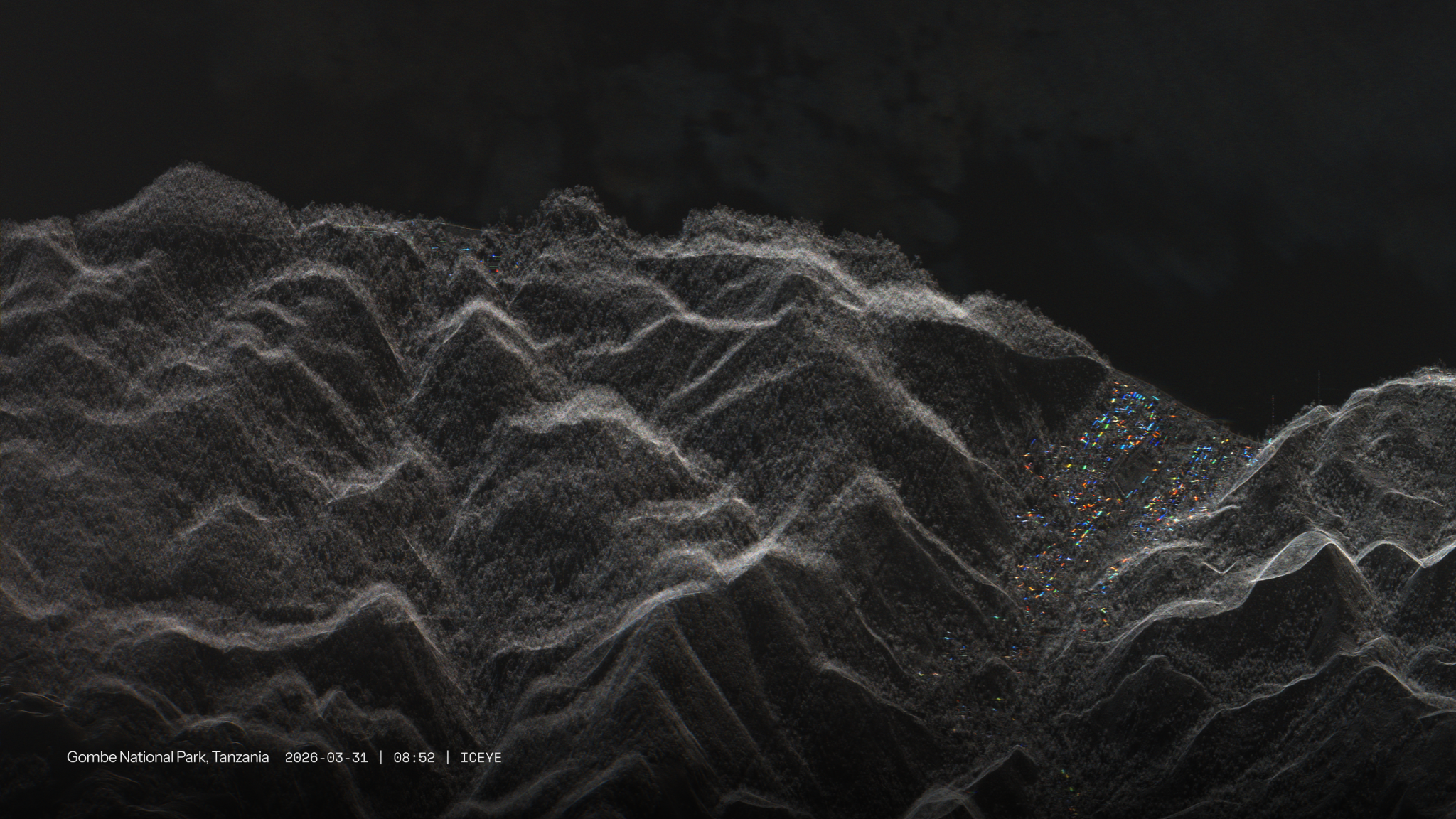
The ICEYE Synthetic Aperture Radar image below is Gombe National Park in western Tanzania. This site is where Dr. Jane Goodall began her groundbreaking chimpanzee research in 1960.
Looking ahead, how do you see ICEYE and SAR shaping conservation?
Dr. Lilian Pintea: It is now clear that in many areas important for conservation, satellites cannot deliver on this mission without SAR. The question is no longer whether the capability exists; it is how quickly the data can reach the people who need it in a form they can use. NGOs do not have the time or the technical capacity to process raw SAR. Decision-ready outputs delivered to the places that matter most — community and government protected areas in eastern DRC, western Tanzania, and similar landscapes — are what move this from technology to conservation impact on the ground.
In many places around the world, including in landscapes across Africa, many decisions are being made right now without evidence to back them. We need more collaborative spaces where decision-makers can interact with the data, develop trust, and act on it together. That requires us to understand how local decisions are made, including resources and capacities available, and listen to what rangers, communities, and governments actually need, and to feed that back to partners like ICEYE so the products keep getting more actionable and useful. This reflects the spirit of JGI's community-led conservation approach, called Tacare, and one of Jane's founding principles: conservation that starts with the people who live alongside the forest.
30 September 2026
03 September 2026

06 August 2026