Contact us
Get in touch with our experts to find out the possibilities daily truth data holds for your organization.


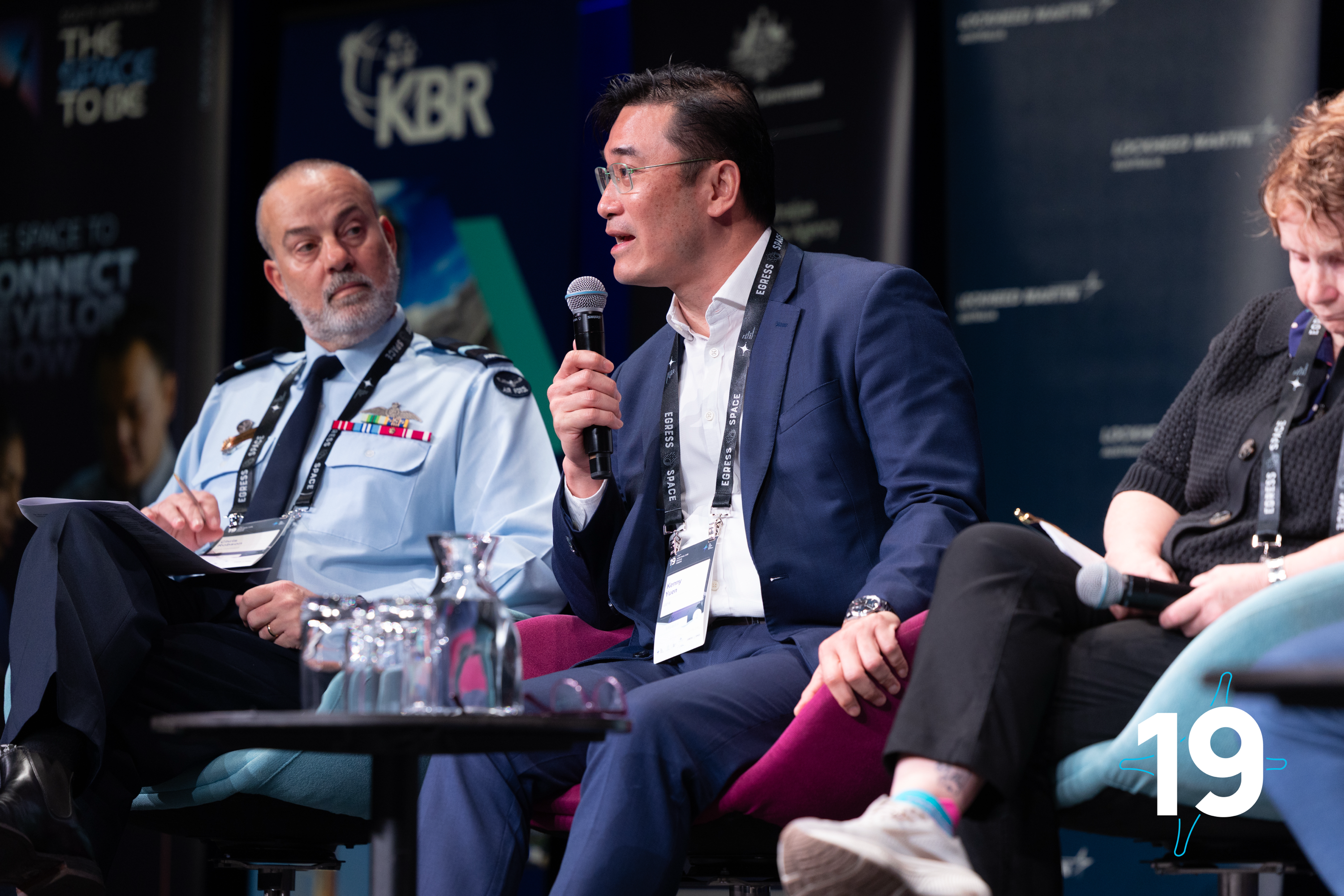
ICEYE took part in a panel discussion at the Australian Space Forum in Adelaide, addressing what happens to Australia's critical infrastructure when space capabilities are compromised. Kenny Yuen, our Vice President Missions, Australia & New Zealand, was ICEYE's panelist, appearing alongside leaders from the Australian Defence Force, Optus, the Royal Flying Doctor Service and Flinders University.
The panel examined space capabilities and their impact on Australian critical infrastructure, bringing together defence, telecommunications, emergency health services and research perspectives on a single question: what does space actually enable, and what happens when that access is lost.
Losing access to space capabilities is not a single-sector problem. Defence, energy, transport, agriculture, finance and emergency services all depend on space-based positioning, communications and Earth observation in ways that are often invisible until they fail. Panelists set out the vulnerabilities this dependency creates across each of these industries, and what a loss of access would mean in practice for the systems that keep the country running. They also pointed to how those vulnerabilities get mitigated in practice: diversifying sources of space data, building sovereign or allied-shared capacity rather than depending on a single provider, and designing constellations large enough to keep operating even if individual satellites are lost.
That dependency ties directly to resilience, sovereignty and economic wellbeing. A nation that cannot independently access, monitor or verify its own space-based data is exposed at exactly the moments it needs that data most, whether that is a natural disaster, an infrastructure failure or a deliberate act of disruption. Sovereign control over space capability is what keeps that exposure from becoming a national vulnerability.
Yuen drew on ICEYE's own operational record to ground the discussion. ICEYE's satellite-derived flood and disaster intelligence has supported more than 75 organisations across Australia, including the response to ex-Tropical Cyclone Alfred in 2025. The same constellation and software underpin the sovereign SAR (synthetic aperture radar) missions ICEYE has delivered to defence customers in Finland, Poland, the Netherlands, Sweden and Germany, and the ISR support ICEYE has provided to Ukraine since 2022. Those deployments, across both disaster response and defence, are the lessons ICEYE brought to the panel: sovereign space capability has to work in peacetime and in crisis, and the systems that prove themselves in one context carry directly into the other.
Sharing a stage with defence, telecommunications, health and research leaders made one point clear: none of these organizations can carry critical infrastructure resilience alone. Each depends on the others, and on the space capabilities underneath all of them. ICEYE's contribution to that shared task did not end when the panel did. It continues in the sovereign missions and disaster response work already running across Australia today.
%20(1).png)
01 September 2026
.png?width=480&height=270&name=image%20(9).png)
01 September 2026